
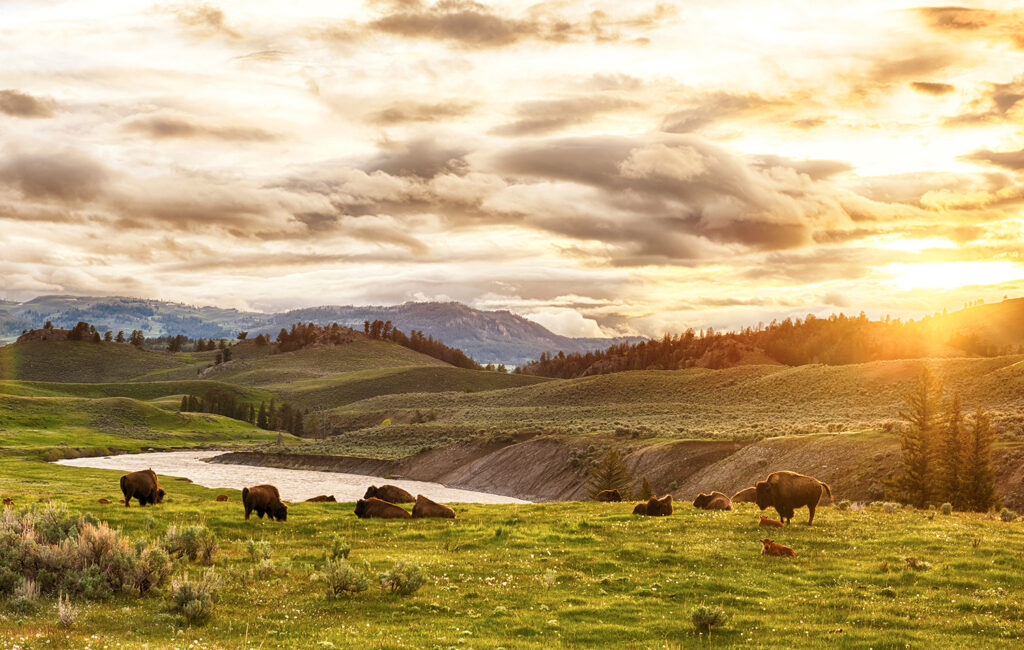
The South Entrance Is a Slow Beginning
Yesterday, I came into Yellowstone through the South Entrance.
And I want people to understand something about that road.
It is beautiful.
Not kind of beautiful.
Deep beautiful.
Tall evergreens. Blue water. Quiet lakes. Mountains holding the edges. Burned forest and fallen trees and all that strange Yellowstone country where you can feel the park rebuilding itself in silence.
If you are coming from Grand Teton and driving north into Yellowstone, this is one of those roads that makes the trip feel bigger than the destination.
But it is also not always the road where the wildlife starts showing itself right away.
Some roads are for scenery first
Not every road in Yellowstone is loud with animals.
Some roads are quiet.
Some roads are scenic.
Some roads are the kind of place where you look out the window and stop needing the day to hurry.
The South Entrance can feel that way.
You might see the occasional bison. Maybe elk. Maybe something moving at the edge of the trees if the timing is right.
But compared to other parts of the park, this stretch can be harder for wildlife watching.
There is thick forest. Burned timber. downed trees. Big water. Country that looks wide and wild, but does not always give you easy views into where animals are moving.
That does not make it a bad drive.
It makes it a different kind of drive.
Why the map may look quiet there
If you are using the interactive wildlife map and you notice that the South Entrance stretch looks quieter, that is intentional.
I am not trying to make every piece of the park look busy just to fill space.
That would be dishonest.
The map is built from fieldwork.
If an area is active, I mark it.
If an area is quiet, that tells you something too.
Sometimes the best information is not where to go.
Sometimes the best information is where not to burn your best wildlife hour.
That is the difference between an old paper map and a field-built online map.
An old map shows icons.
This map shows recent activity, quiet zones, and the shape of what I am actually seeing in the park.
Where the wildlife starts to build
When you come up from Grand Teton and enter Yellowstone from the south, let that first stretch be what it is.
A scenic entrance.
A slow beginning.
A place to breathe before the wildlife day starts getting louder.
As you move farther north and work your way toward Yellowstone Lake, West Thumb, Lake Village, and especially toward the Fishing Bridge side, the day can start to change.
That is where the country opens in different ways.
That is where more wildlife activity can begin to show itself.
That is where the map starts giving you more to work with.
Not guarantees.
Never guarantees.
But better context.
Grand Teton first, Yellowstone next
If you are driving from Grand Teton into Yellowstone, you are already doing one of the great routes in the country.
Grand Teton can give you moose, bison, elk, bears, pronghorn, waterfowl, and those mountains that make every road feel like it is aimed at something sacred.
Then Yellowstone begins slower from the south.
That is okay.
Let it.
Do not judge that entrance only by how many animals you see in the first few miles.
Use it as part of the story.
Let the lakes and evergreens do their work.
Let the road carry you north.
Then, when the landscape starts opening and the map starts showing more recent field observations, shift into wildlife mode.
This is how you plan a better day
The goal is not to chase every road equally.
The goal is to know what kind of road you are on.
- Some roads are for scenery.
- Some roads are for patience.
- Some roads are for watching water and willows.
- Some roads are worth your first light.
- Some roads are better later in the day.
That is why the map matters.
It helps you stop treating the whole park like one giant guessing game.
It helps you understand where the wildlife activity has been building, and where the drive is more about beauty than animals.
The quiet roads matter too
I loved the South Entrance drive yesterday.
Even without a heavy wildlife day there, I loved it.
Because Yellowstone is not only the animal standing in the road.
It is the water.
The trees.
The burned places coming back.
The blue lakes and long curves and that feeling that you are entering something older than your plans.
So yes, take the South Entrance.
Drive it from Grand Teton.
Enjoy the quiet stretch.
Just know what it is.
It is not empty.
It is preparing you.
If you want to plan a calmer day in Yellowstone or Grand Teton, explore the interactive wildlife map. The online map shares recent field observations posted after fieldwork so you can shape tomorrow without chasing rumors, crowds, or brake lights.
Plan tomorrow tonight.
Keep wildlife wild.


