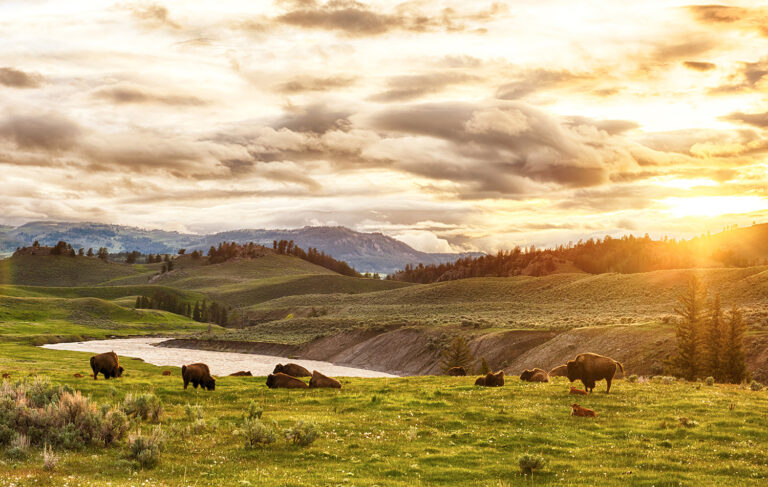
The Bison Wasn’t Just Rolling in the Dirt
A grandfather and his grandson were walking through Bridge Bay Campground when they saw a bull bison rolling around in the dirt.
They appeared to be a fair distance away.
The grandfather even recognized when it was time to leave. He moved behind the trees and tried to get away.
It was not enough.
The bull pursued him around the trees, caught him with a horn, and threw him into the air.
This is not another story about calling a visitor stupid.
According to the witness, the man and his grandson were trying to be respectful. The bull had already charged toward other people and was moving through the campground in an agitated state.
The lesson is bigger than distance alone.
The lesson is learning to recognize when an animal is telling you that the normal rules of the moment have changed.
The mistake is thinking the bison looks relaxed
Most visitors see a bison rolling in the dirt and think it looks playful.
Maybe it is scratching its back.
Maybe it is taking a dust bath.
Maybe it is giving everyone a funny video for the ride home.
Sometimes wallowing can be connected to insects, shedding, dust bathing, or cooling down.
But during the rut, wallowing can also be part of a bull’s breeding behavior and display.
July is not the time to look at a mature bull rolling in the dirt and assume you are watching a slow, peaceful animal.
You are looking at an animal carrying enormous weight, speed, hormones, and energy.
In Yellowstone, even the dust can carry a message.
The rest of the scene matters
When I am watching bison in the field, I do not read one movement by itself.
I read the entire environment.
If I see 40 bison in an open field and several bulls are wallowing, bellowing, challenging one another, and moving among cows, I understand the context.
The bulls have other bison around them. Their attention may be moving between competitors and females. You can watch the energy travel through the herd.
That does not mean I move closer. The required distance still matters, and an active rutting herd deserves even more room.
But the herd gives me information.
A lone bull entering a campground is different.
There are tents, children, vehicles, picnic tables, blind corners, and people who may not even know the animal is there.
If that bull is wallowing, charging vehicles, staring toward people, or moving without settling, I do not see a photo opportunity.
I see an alarm.
There may be no herd around to help explain where his attention is going next. That lack of context makes me more cautious, not less.
Watch the animal before you watch your camera
A phone or camera pulls your attention into a tiny rectangle.
The animal is still moving in the entire world around it.
Before lifting the camera, watch for changes in behavior:
- staring directly at people
- head bobbing
- pawing at the ground
- bellowing
- raising the tail
- repeatedly getting up and settling down
- pacing or changing direction toward people
- charging animals, vehicles, or nearby objects
Wallowing by itself does not guarantee that a charge is coming.
But wallowing during the rut, combined with agitation and a bull moving alone through a developed area, should make you widen the distance immediately.
Do not wait for every warning sign to appear.
Wild animals do not complete a checklist before they move.
Twenty-five yards is a minimum
Yellowstone requires visitors to stay at least 25 yards from bison.
That distance is not a magical wall.
If a bull is agitated, give it far more room.
Move into a vehicle or building when possible. Put substantial cover between you and the animal. A few thin bushes should not be your entire escape plan.
If the bison begins moving toward you, leave immediately. Do not stand there trying to decide whether it is a real charge or a bluff.
Bison can close distance faster than most people understand.
The safest photograph is often taken from inside your vehicle with a long lens.
This is why learning matters
Where the Wild Beasts Roam is not only about helping people find animals.
Finding the animal is the beginning.
People also need to understand what they are seeing.
They need to know when a bull is feeding, when a herd is moving, when mothers are protecting calves, when the rut is changing the energy, and when the right move is to put the camera down and leave.
That knowledge protects visitors.
It protects the animal from being blamed for behaving like a wild animal.
And it gives people a better chance to experience Yellowstone without becoming part of the next frightening video.
If you are trying to figure out where bison have been active, which roads are worth watching, or how seasonal behavior is changing across Yellowstone and Grand Teton, explore the interactive wildlife map. It shares recent field observations posted after fieldwork so you can begin with more knowledge and spend less time driving blind.
Plan tomorrow tonight.
Keep wildlife wild.